Warehouse & Material Handling · Gulf Countries · 2026
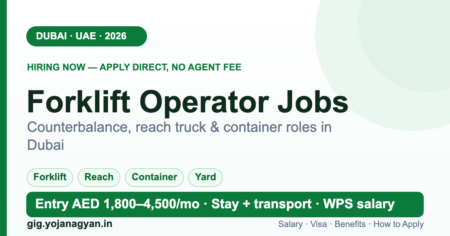
Forklift operator jobs across the Gulf — the certificate that pays, honest ranges, and how to apply direct
Forklift operatorReach truckPallet / order pickerWarehouse operativeTeam leader
Where: UAE, Saudi Arabia, Qatar, Oman, Bahrain and Kuwait
Written for 2026 hiring · pay ranges are indicative, not a promise
Common operator pay
AED 1,800–3,200 / mo
Usually included
Stay + transport
Salary route
Paid by bank via WPS
Needed
Forklift certificate
✓No agency fee to the worker✓Health insurance by law✓Salary through WPS✓Cities, not company addresses
Ramesh had driven a forklift for years and wanted to put that skill to work in the Gulf. He wanted the plain facts: is it real, what does a forklift operator actually earn there, and does his certificate count. This guide answers that honestly for forklift jobs across the Gulf.
Warehouses, factories, ports and free zones across the Gulf run on material handling, so certified forklift operators are in steady demand. Logistics and industrial employers hire them in numbers, and the same rules apply across all of them. Read this before any agent.
Why the Gulf keeps hiring for this in 2026
The Gulf’s warehouses, factories, ports and free zones move enormous volumes of goods, and almost all of it is lifted, stacked and moved by forklift and material-handling machines. That constant need makes a certified forklift operator one of the steadiest skilled roles in Gulf logistics and industry.
New warehouses and fulfilment centres open constantly, and each needs operators. For a trained, certified operator, this is one of the most reliable skilled routes into the Gulf — and better-paid than general warehouse work because the certificate and skill are in demand.
The job behind the advert — what the day really looks like
This is skilled machinery work in warehouses, yards and factories, on a shift system, with strict safety rules. You move, stack and load goods safely and accurately, and keep the machine and area safe.
A forklift operator lifts and stacks pallets with a counterbalance truck. A reach truck operator works tall racking in narrow aisles. A pallet or order picker picks stock to orders. A warehouse operative supports the operation on foot, and a team leader runs a shift and its crew.
Who can get in — and who honestly cannot yet
Read this before you apply
- ✓A recognised forklift certificate and real operating experience are what employers want.
- ✓Safe, accurate handling — stacking cleanly without damage is the skill that pays.
- ✓Physically fit and alert for full shifts around moving machinery.
- ✓Valid passport with 12+ months left before expiry.
- ✗If you have never operated a forklift, start as a warehouse operative and get certified rather than claim operator.
- ✗If an ‘agent’ wants a big fee for a guaranteed operator job, that is not how genuine hiring works.
What the roles pay — honest ranges, not salary-site guesses
Forklift pay depends on the country, the employer, the machine and your experience, and overtime is common on busy sites. The bars below are rough monthly basics in UAE dirhams; the Saudi, Qatari and Omani equivalents are broadly similar. A recognised certificate and clean record are what lift you above general warehouse pay.
Warehouse operative (no cert)AED 1,600–2,100Fairly reliable
Pallet / order pickerAED 1,700–2,300Not verified
Forklift operator (certified)AED 2,000–3,000Fairly reliable
Reach-truck operatorAED 2,300–3,400Not verified
Senior / multi-machine operatorAED 2,800–4,000Not verified
Warehouse / shift team leaderAED 3,200–5,000Fairly reliable
Bars show rough relative pay, not a promise. Actual pay depends on employer, experience and package.
Note: Ignore single ‘average’ numbers that mix machines and countries. Your safe figure is the basic in your offer letter; overtime and multi-machine skills are on top. A recognised forklift or reach-truck certificate is the single biggest thing that raises a material-handling wage.
The machines and skills that pay
Forklift work is the heart of material handling equipment — counterbalance trucks, reach trucks, order pickers and pallet trucks that move every pallet in a warehouse. Employers value operators who are certified, safe and accurate, and who can run more than one machine. Knowing the words helps at interview: counterbalance, reach truck, mast, load chart, racking and stacking. A no-damage, safety-first operator is exactly what a logistics employer rewards with the higher-paid multi-machine and team-leader roles.
| You operate |
Material-handling equipment |
| Skill that pays |
Certified, safe, no-damage stacking |
| Growth path |
Operator → multi-machine → team leader |
The checklist that gets your file shortlisted
What a clean application looks like
- ✓A one-page CV with your photo, phone number and any relevant experience.
- ✓A clear passport scan with 12+ months of validity.
- ✓Any certificate, licence or experience letter you hold, scanned neatly.
- ✓A working WhatsApp number — Gulf recruiters shortlist there.
- ✗You do NOT need a paid ‘visa consultant’ to apply for a genuine job.
Where the jobs actually are — and who is hiring
The jobs cluster around warehouses, factories, ports and free zones. In the UAE that means Dubai, Jebel Ali, Abu Dhabi and Sharjah; add Riyadh, Jeddah and Dammam in Saudi Arabia, plus industrial zones in Doha, Muscat, Manama and Kuwait City. Logistics and industrial employers hire operators across all of these.
We name cities and zones, not individual sites, because postings change with volume. Apply through the employer’s official channel and be ready to state your certificate, the machines you run, and your years of experience.
Housing and the real-estate side of the offer
Most warehouse and logistics employers provide shared staff accommodation near the site or free zone, or a housing allowance, plus transport. This is the real estate side to check: distance from the warehouse, how many share a room, whether transport is included, and any deduction. A clear written answer on housing marks a reputed employer over a middleman. Ask before you accept and weigh any allowance against local rent.
| Usually provided |
Shared accommodation + transport |
| Always confirm |
Distance, sharing, any deduction |
| Good sign |
Housing written into the offer |
Visa, residence and medical — how the paperwork really works
The employer sponsors your work permit and entry visa. After you land you complete a medical test and biometrics, and the company processes your residence permit — the iqama in Saudi Arabia and the Emirates ID and residence in the UAE. Arranging this is the employer’s job, not something you buy from an agent.
You keep your own passport, and in most Gulf states an employer cannot legally hold it against your will. Once residence is issued, your salary bank account and health insurance are set up and your pay begins flowing through WPS.
From application to arrival — the real steps
1
Fix your documents first
Passport, a one-page CV with photo, and any experience letter. Save clear PDFs on your phone.
2
Apply on official channels
Use the employer’s own careers page and trusted portals. Avoid random ‘agents’ in WhatsApp groups.
3
Video or phone interview
A short chat about your experience, availability and English. Be honest about what you have done.
4
Offer letter — read every line
Check basic pay, allowances, accommodation, transport, hours and deductions before you sign.
5
Medical and visa
The employer arranges the permit, medical and, after arrival, your residence. You pay no worker fee.
Shifts, hours and the shape of a real working day
Warehouses and yards run long hours, often 24/7, so this is shift work — days, evenings and nights on rotation, including weekend and peak-season surges. A duty is usually 8 to 9 hours, and overtime is common when volume rises.
It is skilled, safety-first machinery work. If you operate safely and stack accurately, it is a well-paid, in-demand trade with a clear ladder into multi-machine and supervisory roles.
Two offers, side by side — spotting a good one from a trap
A genuine offer looks like this
- •Employer pays for the visa and work permit
- •Salary paid by bank through WPS
- •Health insurance arranged by the company
- •Written offer letter with pay and deductions
- •Accommodation or allowance stated clearly
Walk away if you see this
- •‘Pay now to lock the seat’
- •Salary promised only in cash, off the books
- •No contract, only voice notes and screenshots
- •Vague ‘selection fee’ or ‘visa deposit’
- •Pressure to decide today, before you can read it
How to earn more than the starting number
The ladder rewards skill: certified operator, then reach-truck and multi-machine operator, then senior operator and shift team leader. The more machines you are certified and trusted on, the more you earn — material-handling skill is genuinely in demand.
A recognised forklift and reach-truck certificate, and a clean no-damage safety record, are the fastest ways to a higher wage — the best investment a material-handling worker can make.
On money, a salary bank account under WPS makes remittance cheap and traceable, and a steady WPS record is what a bank checks if you later ask about a personal loan, a vehicle loan or a salary advance.
⚠ Do not buy a fake forklift certificate
Operator roles pay more than general warehouse work, so scammers sell fake forklift ‘certificates’. A genuine employer skill-tests you on its own machine and verifies the certificate with the issuing body — a fake fails the test and can cost you the job. Train and certify for real; it is the honest, faster route to the higher-paid operator roles.
⚠ Do not travel on a visit visa for a promised job
Some scams fly you in on a visit visa and leave you to find work illegally. A real job is arranged before you travel, with an employer-sponsored work permit — not a ‘come now, we’ll fix papers later’ promise.
Your rights on the ground — the short version
Paid on time, insured, and owed a gratuity
Across the Gulf your salary should be paid through WPS, so it is tracked and on time. Employer health insurance is required by law in the UAE, Saudi Arabia, Qatar and most neighbours. When you leave after the qualifying period, you are owed an end-of-service gratuity based on your basic pay and years worked. Keep your contract and payslips — they are how you check every number is correct.
Safety, insurance and a reputed employer
Forklift work is machinery-heavy, so a reputed warehouse or logistics company carries cargo and liability insurance, provides employer health insurance, and enforces strict safe-operating rules, pedestrian separation and daily machine checks. For you that means proper training, protective gear, a real skill test and wages on the books. A reputed company name and a clean safety record on your CV open doors across logistics. Follow every safety rule and do your machine checks — it protects you and others and marks you as promotable.
| Employer carries |
Cargo + employer health insurance |
| You get |
Training, protective gear, skill test |
| Your part |
Follow safe-operating rules, do machine checks |
Forklift Operator Gulf jobs — quick answers
Do I need a certificate to be a forklift operator in the Gulf?
For operator roles, yes — a recognised forklift certificate and real experience are expected, and you will be skill-tested. As a warehouse operative you can start without one and get certified on the job.
What salary can a forklift operator expect?
Certified operators are commonly advertised around AED 2,000–3,000 a month and reach-truck and multi-machine operators higher (or the local equivalent), usually with shared accommodation and transport, plus overtime. Read the exact offer before you travel.
Does a reach-truck or multi-machine skill pay more?
Yes. The more machines you are certified and trusted on, the more you earn. Reach-truck and narrow-aisle skills are especially valued in tall-racked warehouses.
Is accommodation provided?
Most warehouse and logistics employers provide shared accommodation and transport, or a housing allowance. Confirm in writing what is provided and what is deducted.
Do I have to pay an agent?
No. A genuine Gulf employer does not charge the worker for the visa or the job. Anyone asking money for a ‘guaranteed forklift job’ is a red flag — stop.
Will I get health insurance?
Yes. Employer health insurance is a legal requirement for workers across the Gulf, arranged as part of your visa and residence.
Will I be skill-tested?
Usually yes. Employers test operators on their own machines and check certificates against the issuing body, so a genuine certificate and real skill matter. A fake certificate fails the test.
What about end-of-service pay?
After the qualifying period, most Gulf countries pay a gratuity based on your basic salary and years of service. Keep your contract and payslips to check it.
Ready to apply? Fix your passport and a one-page CV, apply only through official careers pages and trusted portals, and remember the golden rule of Gulf hiring — a real job never asks the worker to pay for the visa or the offer.
Disclaimer: This article is general information for job seekers and reflects typical 2026 conditions across the Gulf. Pay, benefits and rules vary by country and employer and can change. This site is independent and is not affiliated with, endorsed by, or an official recruitment channel for any warehouse, logistics or industrial employer named for context. Always verify openings and terms on the official company website before applying, and never pay money to secure a job or visa.
Dedicated to researching and publishing informative content related to gig work, freelance opportunities, remote jobs, online earning options, and career development. Committed to delivering accurate, reader-friendly, and useful information for individuals seeking flexible work opportunities.