Riyadh Metro · Ticketing & Customer Service · 2026
Riyadh Metro ticket counter jobs — fare, card and customer-service roles, honest pay and how to apply
Ticket counter agentCard sales & top-upCustomer serviceRefunds & queriesTicket office supervisor
Where: UAE, Saudi Arabia, Qatar, Oman, Bahrain and Kuwait
Written for 2026 hiring · pay ranges are indicative, not a promise
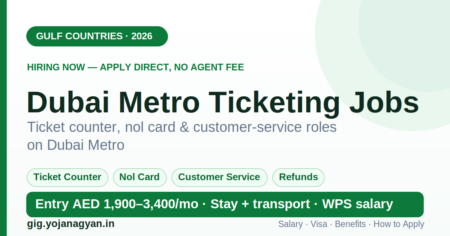
Common entry pay
SAR 2,000–3,200 / mo
Usually included
Stay + transport
Salary route
Paid by bank via WPS
Cover
Health insurance by law
✓No agency fee to the worker✓Health insurance by law✓Salary through WPS✓Cities, not company addresses
Adil wanted a clean, indoor, customer-service job in Riyadh and kept seeing “Riyadh Metro ticket counter” adverts. He had simple questions before replying: is it real, what does it pay, and who can apply. Here are honest answers, before any agent gets involved.
Riyadh Metro — one of the world’s largest driverless metro systems, with six lines across the Saudi capital — opened to passengers from late 2024, and its stations need ticketing and customer-service staff to sell fares and cards, answer queries and help new riders. A brand-new network means fresh hiring.
Why the Gulf keeps hiring for this in 2026
Riyadh’s new metro is drawing large numbers of first-time riders as the city shifts onto public transport, and each station has a ticketing and customer-service point for card sales, top-ups, refunds and help. New riders need real people at the counter, so ticketing and service roles are in steady demand.
You do not need a degree — you need presentation, clear English and a helpful, honest manner with cash and cards. A tidy Class 12 pass who is accurate with money and calm with queues is exactly who the metro operator and its service partners hire; Arabic is a strong plus.
The job behind the advert — what the day really looks like
This is clean, indoor, customer-facing work at a station counter on a shift system. You sell and top up travel cards, explain fares and lines, process refunds within the rules, handle cash and card payments accurately, and help travellers — many new to the metro — at the ticket office.
A ticket counter agent sells fares and cards and takes payment. A card sales & top-up agent manages card issues and balances, a customer service host answers route and fare queries, a refunds & queries agent handles adjustments, and a ticket office supervisor runs the shift and the till.
Who can get in — and who honestly cannot yet
Read this before you apply
- ✓Presentable, Class 12 pass — this is a smart, customer-facing counter role.
- ✓Clear English to help riders and tourists; other languages help.
- ✓Accurate with cash and cards and comfortable with a simple ticketing system.
- ✓Valid passport with 12+ months left and honesty with money and records.
- ✗If steady queues and cash handling frustrate you, a different transit role may suit better.
- ✗No genuine operator charges a worker a fee for a ‘guaranteed counter job’ — a red flag.
What the roles pay — honest ranges, not salary-site guesses
Metro ticketing pay depends on the operator or service partner, the role and shift patterns, and Arabic or language allowances are common. The bars below are typical monthly basics in Saudi riyal; similar transit roles across the Gulf pay a broadly similar band in their own currency.
Junior counter agentSAR 1,900–2,600Fairly reliable
Card / top-up agentSAR 2,000–2,800Fairly reliable
Ticket counter agentSAR 2,300–3,200Fairly reliable
Customer-service hostSAR 2,200–3,000Not verified
Senior counter agentSAR 2,700–3,700Not verified
Ticket office supervisorSAR 3,500–5,200Fairly reliable
Bars show rough relative pay, not a promise. Actual pay depends on employer, experience and package.
Note: Ignore single ‘average salary’ figures online that lump every employer and country together. Your safe number is the basic written in your own offer letter; allowances and overtime are separate and should be listed clearly.
How metro ticketing works around you
Counter work sits inside a professional fare-collection and customer-service system — travel-card management, cash and card reconciliation, refund policy and a service standard set by the operator. You are trained on the ticketing system and secure cash handling. A reputed operator or service partner runs this properly, and the counter is a common first step into station and operations roles.
| You work within |
Fare collection + customer service |
| You learn |
Ticketing system, cash reconciliation |
| Growth path |
Counter → supervisor → station ops |
The checklist that gets your file shortlisted
What a clean application looks like
- ✓A one-page CV with your photo, phone number and any relevant experience.
- ✓A clear passport scan with 12+ months of validity.
- ✓Any certificate, licence or experience letter you hold, scanned neatly.
- ✓A working WhatsApp number — Gulf recruiters shortlist there.
- ✗You do NOT need a paid ‘visa consultant’ to apply for a genuine job.
Where the jobs actually are — and who is hiring
The jobs sit across Riyadh Metro stations and the operator or service partner that staffs them. Similar transit ticketing and customer-service roles run across the Gulf — Dubai in the UAE, and public-transport systems in Doha, Jeddah and beyond — so skills transfer well.
As the network grows its lines and ridership, hiring waves continue. Apply through the operator or official service partner’s careers channel for Riyadh, never a stranger charging a fee.
Housing, allowances and what to check first
Most packages cover housing one of two ways: provided accommodation with transport, or a monthly housing allowance you spend yourself. The real estate fine print — sharing, location and deductions — is where offers differ most. Get it in writing, and if you are given an allowance, price a real room nearby before you decide it is enough.
| Provided or allowance |
Confirm which you get |
| Fine print |
Sharing, location, deduction |
| Do the maths |
Allowance vs actual rent |
Visa, residence and medical — how the paperwork really works
The employer sponsors your work permit and entry visa. After you land you complete a medical test and biometrics, and the company processes your residence permit — the iqama in Saudi Arabia and the Emirates ID and residence in the UAE. Arranging this is the employer’s job, not something you buy from an agent.
You keep your own passport, and in most Gulf states an employer cannot legally hold it against your will. Once residence is issued, your salary bank account and health insurance are set up and your pay begins flowing through WPS.
From application to arrival — the real steps
1
Fix your documents first
Passport, a one-page CV with photo, and any experience letter. Save clear PDFs on your phone.
2
Apply on official channels
Use the employer’s own careers page and trusted portals. Avoid random ‘agents’ in WhatsApp groups.
3
Video or phone interview
A short chat about your experience, availability and English. Be honest about what you have done.
4
Offer letter — read every line
Check basic pay, allowances, accommodation, transport, hours and deductions before you sign.
5
Medical and visa
The employer arranges the permit, medical and, after arrival, your residence. You pay no worker fee.
Shifts, hours and the shape of a real working day
The metro runs long service hours, so this is shift work — early starts, evenings and weekends on rotation, heaviest at commuter peaks and during events. A duty is usually 8 to 9 hours with breaks, and unsocial hours often carry an allowance.
It rewards people who are reliable and can rotate through the roster. If you can only work fixed daytime hours, a different role will suit you better.
Two offers, side by side — spotting a good one from a trap
A genuine offer looks like this
- •Employer pays for the visa and work permit
- •Salary paid by bank through WPS
- •Health insurance arranged by the company
- •Written offer letter with pay and deductions
- •Accommodation or allowance stated clearly
Walk away if you see this
- •‘Pay now to lock the seat’
- •Salary promised only in cash, off the books
- •No contract, only voice notes and screenshots
- •Vague ‘selection fee’ or ‘visa deposit’
- •Pressure to decide today, before you can read it
How to earn more than the starting number
There is a real ladder: from the entry role to senior, then supervisor, and on into station and transport operations, with pay rising at each step. Operators back staff who are accurate, calm and helpful with riders.
On the money side, a salary bank account under WPS makes remittance home cheap and traceable, and a steady WPS record is what a bank looks at if you ever ask about a personal loan later.
⚠ Never pay for a ‘guaranteed metro job’
A real metro operator or official service partner does not charge the worker for a visa or a seat. ‘Registration fee’, ‘uniform deposit’ and ‘guaranteed selection’ are the classic trap. If money is asked before a genuine offer letter, stop and verify on the official careers page.
⚠ Do not travel on a visit visa for a promised job
Some scams fly you in on a visit visa and leave you to find work illegally. A real job is arranged before you travel, with an employer-sponsored work permit — not a ‘come now, we’ll fix papers later’ promise.
Your rights on the ground — the short version
Paid on time, insured, and owed a gratuity
Across the Gulf your salary should be paid through WPS, so it is tracked and on time. Employer health insurance is required by law in the UAE, Saudi Arabia, Qatar and most neighbours. When you leave after the qualifying period, you are owed an end-of-service gratuity based on your basic pay and years worked. Keep your contract and payslips — they are how you check every number is correct.
Insurance, safety and a reputed operator
A metro is a high-footfall, safety-critical service, so the operator carries commercial and liability insurance, provides employer health insurance for staff, and enforces strict safety and service rules. For you that means a health card, safety training, uniform and clear procedures. A reputed operator on your CV also helps your next move in transport or public service.
| Operator carries |
Liability + employer health insurance |
| You receive |
Health card, safety training |
| Your part |
Follow safety and service rules |
Riyadh Metro Ticket Counter Staff Gulf jobs — quick answers
Do I need experience for a Riyadh Metro ticket counter job?
Not usually — you are trained on the ticketing system. Clear English (Arabic helps), a presentable manner, accuracy with cash and cards, and honesty matter most.
What salary can I expect?
Entry ticketing and customer-service roles are commonly advertised around SAR 2,000–3,200 a month, usually with accommodation and transport, plus language allowances. Confirm the exact offer.
Is accommodation provided?
Most transport employers and service partners provide shared accommodation and transport, or a housing allowance. Confirm in writing what is provided and what is deducted.
Do I have to pay an agent to get hired?
No. A genuine metro operator or official partner never charges the worker for a visa or a ‘guaranteed’ job. Any such demand is a scam — walk away.
Does Arabic help on the Riyadh network?
Yes. Arabic is valued at a Saudi network alongside English, and other languages such as Hindi, Urdu or Tagalog can also help you get hired and earn an allowance.
Will I get health insurance?
Yes. Employer health insurance is a legal requirement in Saudi Arabia and across the Gulf, arranged with your iqama and residence, and you receive a health card.
How is my salary paid?
Through the bank under the Wage Protection System (WPS), so pay is tracked and on time. A salary account also makes sending money home cheaper.
What about end-of-service pay?
After the qualifying period Saudi Arabia and other Gulf countries pay an end-of-service gratuity based on your basic salary and years of service. Keep your contract and payslips.
Ready to apply? Fix your passport and a one-page CV, apply only through official careers pages and trusted portals, and remember the golden rule of Gulf hiring — a real job never asks the worker to pay for the visa or the offer.
Disclaimer: This article is general information for job seekers and reflects typical 2026 conditions in the Gulf. Pay, benefits and rules vary by employer and can change. This site is independent and is not affiliated with, endorsed by, or an official recruitment channel for the Riyadh Metro operator, the Royal Commission for Riyadh City, or any company named for context. Always verify openings and terms on the official company website before applying, and never pay money to secure a job or visa.
Dedicated to researching and publishing informative content related to gig work, freelance opportunities, remote jobs, online earning options, and career development. Committed to delivering accurate, reader-friendly, and useful information for individuals seeking flexible work opportunities.