Metro & Rail Transport · Gulf Countries · 2026
Metro & railway jobs across the Gulf — real roles keeping the trains running, and how to apply direct
Station staffStation cleaningCustomer serviceTrack maintenance helperDepot helper
Where: UAE, Saudi Arabia, Qatar, Oman, Bahrain and Kuwait
Written for 2026 hiring · pay ranges are indicative, not a promise
Common entry pay
AED 1,400–2,400 / mo
Usually included
Stay + transport
Salary route
Paid by bank via WPS
Cover
Health insurance by law
✓Worker pays no recruitment fee✓Medical cover by employer✓WPS-tracked wages✓Keep your own passport
Prakash wanted a steady public-transport job and kept seeing “metro jobs” and “railway jobs” adverts for the Gulf. He wanted the honest picture: what are the real roles, what do they pay, and who can apply. This guide answers that plainly for metro and railway jobs across the Gulf.
Gulf cities are building and expanding metro and rail networks, and each line needs a large team to run stations, keep them clean, help passengers and maintain the track and depots. Metro and rail operators across the region hire this way, and the same rules apply to all of them.
Why the Gulf keeps hiring for this in 2026
The Gulf is investing heavily in metro and rail — new lines, stations and a growing regional railway network. Running all of it needs station staff, cleaners, customer-service agents and maintenance helpers around the clock, so metro and railway roles are a steady, growing source of jobs.
For a reliable 10th or 12th pass worker, metro and rail is one of the most structured and stable entry routes into the Gulf — genuine work on major public infrastructure, offered by reputed operators and their contractors, not paid agents.
The job behind the advert — what the day really looks like
Metro and rail work runs on strict shifts and safety rules, across stations, trains and depots. Most entry roles are station operations, cleaning, customer service and maintenance-helper jobs that keep the network safe and running.
A station staff member manages gates, platforms and passenger flow. Station cleaning staff keep stations and trains spotless. A customer service agent helps passengers with tickets and directions. A track maintenance helper supports engineering teams, and a depot helper supports train cleaning and stabling.
Who can get in — and who honestly cannot yet
Read this before you apply
- ✓Reliable and punctual — metro and rail run on strict timetables and safety rules.
- ✓Basic English to help passengers and follow procedures; more for customer roles.
- ✓Able to work shifts, including early mornings and nights, and pass a safety induction.
- ✓Valid passport; a clean record for the security and safety checks.
- ✗If you cannot follow strict safety and timetable rules, rail operations is not the right fit.
- ✗If an ‘agent’ wants a big fee for a guaranteed metro job, that is not how genuine hiring works.
What the roles pay — honest ranges, not salary-site guesses
Metro and rail pay depends on the country, the operator and the role, and shift and night allowances are common. The bars below are rough monthly basics in UAE dirhams; the Saudi, Qatari and Omani equivalents are broadly similar. Trust the written offer over any website.
Station cleaningAED 1,400–1,900Fairly reliable
Depot / train cleaning helperAED 1,450–2,000Not verified
Station staffAED 1,700–2,600Fairly reliable
Customer-service agentAED 2,000–3,000Not verified
Track maintenance helperAED 2,100–3,200Not verified
Station / shift supervisorAED 3,000–4,500Fairly reliable
Bars show rough relative pay, not a promise. Actual pay depends on employer, experience and package.
Note: Ignore single ‘average’ numbers that mix roles and countries. Your safe figure is the basic in your offer letter; shift and night allowances are on top. Roles that need a safety induction or licence, like track maintenance, usually pay a little more.
How a metro and rail network is run around you
Metro and rail sit inside public transport and rail infrastructure — a tightly controlled system of stations, signalling, track and depots run to strict safety and timetable standards. You will be trained on station safety, passenger flow and emergency procedures, and maintenance helpers learn track-safety rules. A worker who is punctual and safety-precise is exactly what an operator promotes into station-supervisor and technical roles on major infrastructure.
| You work within |
Public transport and rail infrastructure |
| You learn |
Station safety, passenger flow, procedures |
| Growth path |
Cleaning → station staff → supervisor |
The checklist that gets your file shortlisted
A shortlist-ready application
- ✓A tidy one-page CV with photo, phone and experience.
- ✓Passport scan with plenty of validity left.
- ✓Certificates or reference letters, saved as clear PDFs.
- ✓A phone number that stays reachable on WhatsApp.
- ✗You do NOT owe a worker fee to any ‘consultant’ for a real job.
Where the jobs actually are — and who is hiring
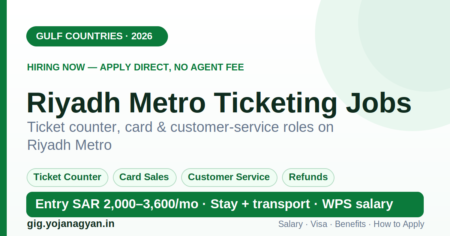
The jobs sit where the networks are. In the UAE that means the Dubai Metro and tram, plus Abu Dhabi and Etihad Rail; in Saudi Arabia, the Riyadh Metro and the wider rail network; plus the Doha Metro, and growing rail projects around Muscat, Manama and Kuwait. Operators and their contractors hire station, cleaning and maintenance staff.
We name networks and cities, not specific stations, because postings change as lines open. Apply through the operator or its facilities contractor’s official channel and state any relevant experience.
Housing and the real-estate side of the offer
Most operators and their contractors provide shared staff accommodation and transport, or a housing allowance. This is the real estate side to check: distance from your depot or line, how many share a room, whether transport is included, and any deduction. A clear written answer on housing marks a reputed employer over a middleman. Ask before you accept and weigh any allowance against local rent.
| Usually provided |
Shared accommodation + transport |
| Always confirm |
Distance, sharing, any deduction |
| Good sign |
Housing written into the offer |
Visa, residence and medical — how the paperwork really works
The route is always employer-led. Your sponsor files the work permit and entry visa, you sit a medical test and biometrics once you reach the country, and your residence permit follows. Anyone charging you a ‘visa fee’ on the side is not part of the legal process.
By law your employer provides health cover and pays your salary through the bank under WPS, so the government can see it was paid in full and on time. Your passport stays with you.
From application to arrival — the real steps
1
Sort the paperwork
Passport, one-page CV with a photo, and any training or experience letters, all scanned clearly.
2
Apply where it is real
Company careers portals and trusted job sites only — a genuine employer never charges you to apply.
3
Shortlist call
Expect a brief WhatsApp or phone screening. Be available, be clear, and confirm your availability.
4
Check the offer closely
Basic salary, overtime, accommodation, transport and any deduction should be written down.
5
Medical, permit, residence
All employer-arranged. If someone asks you for a ‘processing fee’, it is not the real process.
Shifts, hours and the shape of a real working day
Metro and rail run long service hours, so this is strict shift work — early mornings, evenings and nights on rotation, including weekends. A duty is usually 8 to 9 hours, and night and shift allowances are common on top of the basic.
It is structured, safety-first, punctual work. If you are reliable and follow rules carefully, it is one of the most stable public-infrastructure jobs in the Gulf, with a clear ladder.
Two offers, side by side — spotting a good one from a trap
Green flags before you travel
- •Company name you can verify online
- •Salary via bank under WPS
- •Insurance organised by the employer
- •Every term written in the contract
- •Accommodation clearly explained
Red flags to reject
- •Any worker-paid ‘visa charge’
- •Off-the-books cash salary
- •No contract before departure
- •Payment to a middleman’s account
- •‘Decide right now or lose it’ pressure
How to earn more than the starting number
The ladder is real: from cleaning or depot helper into station staff and customer service, then station or shift supervisor, and — with training — toward technical and controller roles. Reputed operators invest heavily in safety training and promote reliable staff.
A little spoken English, a clean safety record, and any relevant induction or licence lift your file for station, customer and maintenance roles that pay more.
On money, a salary bank account under WPS makes remittance home cheap and traceable, and a stable transport-operator salary record is what a bank checks if you later ask about a personal loan or advance.
⚠ Do not trust a ‘government metro job, pay for confirmation’ message
Metro and rail are prestigious, so scammers pose as the operator and ask for a ‘confirmation’ or ‘training deposit’. Real operators and their contractors hire through official channels and never charge the worker to confirm a role. If money is asked before any genuine offer letter, it is fake — verify on the operator’s official site.
⚠ Beware the ‘agent’ who only has your number
Genuine recruiters point you to a company page and give the offer in writing. A middleman who works only through voice notes, screenshots and personal accounts, and who wants money up front, is the pattern to avoid.
Your rights on the ground — the short version
Your basic entitlements on the ground
You should be paid through the Wage Protection System, carry employer health insurance, and receive an end-of-service gratuity calculated on your basic salary. Weekly rest and annual leave are contractual rights. Keep your offer letter and every payslip so the numbers can always be checked.
Safety, insurance and a reputed transport operator
Rail is a safety-critical public system, so a reputed operator carries substantial liability and asset insurance, provides employer health insurance, and enforces rigorous safety, security and emergency procedures. For you that means strong training, a security-checked pass, protective gear and clear rules. A reputed operator on your CV is a solid credential across the growing transport sector. Follow every safety and security rule exactly — on a live railway it protects lives and marks you as promotable.
| Operator carries |
Liability + employer health insurance |
| You get |
Strong training, security pass, protective gear |
| Your part |
Follow safety and security rules exactly |
Metro & Railway Gulf jobs — quick answers
Do I need experience to get a metro or railway job in the Gulf?
For cleaning, depot and many station roles, usually no — the operator trains you and runs a safety induction. Customer-service and maintenance-helper roles prefer some experience. Reliability and safety-mindedness matter most.
What salary can a fresher expect?
Entry cleaning and depot roles are commonly advertised around AED 1,400–2,000 a month (or the local equivalent), and station and customer roles higher, usually with shared accommodation and transport, plus shift allowances. Read the exact offer before you travel.
Is accommodation provided?
Most operators and their contractors provide shared accommodation and transport, or a housing allowance. Confirm in writing what is provided and what is deducted.
Do I have to pay an agent?
No. A genuine Gulf transport operator does not charge the worker for the visa or the job. Anyone asking money for a ‘guaranteed metro job’ is a red flag — stop.
Will I need a safety induction?
Yes. Rail work requires a safety induction and, for some roles, a security-checked pass. A genuine employer arranges these; you should not pay a private party for them.
Will I get health insurance?
Yes. Employer health insurance is a legal requirement for workers across the Gulf, arranged as part of your visa and residence.
Can women apply?
Yes. Women work across station operations, customer service and support roles on Gulf metro and rail networks. Ask about shift timings and accommodation before you accept.
What about end-of-service pay?
After the qualifying period, most Gulf countries pay a gratuity based on your basic salary and years of service. Keep your contract and payslips to check it.
Take it step by step: sort your passport and CV, apply on official channels only, and keep the one rule that protects you — no real Gulf job charges the worker to be hired.
Disclaimer: This article is general information for job seekers and reflects typical 2026 conditions across the Gulf. Pay, benefits and rules vary by country and employer and can change. This site is independent and is not affiliated with, endorsed by, or an official recruitment channel for any metro, rail or transport operator named for context. Always verify openings and terms on the official company website before applying, and never pay money to secure a job or visa.
Dedicated to researching and publishing informative content related to gig work, freelance opportunities, remote jobs, online earning options, and career development. Committed to delivering accurate, reader-friendly, and useful information for individuals seeking flexible work opportunities.